In the Agile world, few metrics are as popular as Team Velocity, often simply called Velocity. At the same time, few metrics are as misunderstood, misused and sometimes feared by development teams.
If you are a Scrum Master, Product Owner or Developer, you have probably heard the phrase:
“we need to increase our velocity.”
But is that really the goal?
In this article in our Agile Metrics series, we take a closer look at Team Velocity to understand what it is, what it is really useful for and, above all, how to prevent it from becoming a double-edged sword.
What is team velocity?
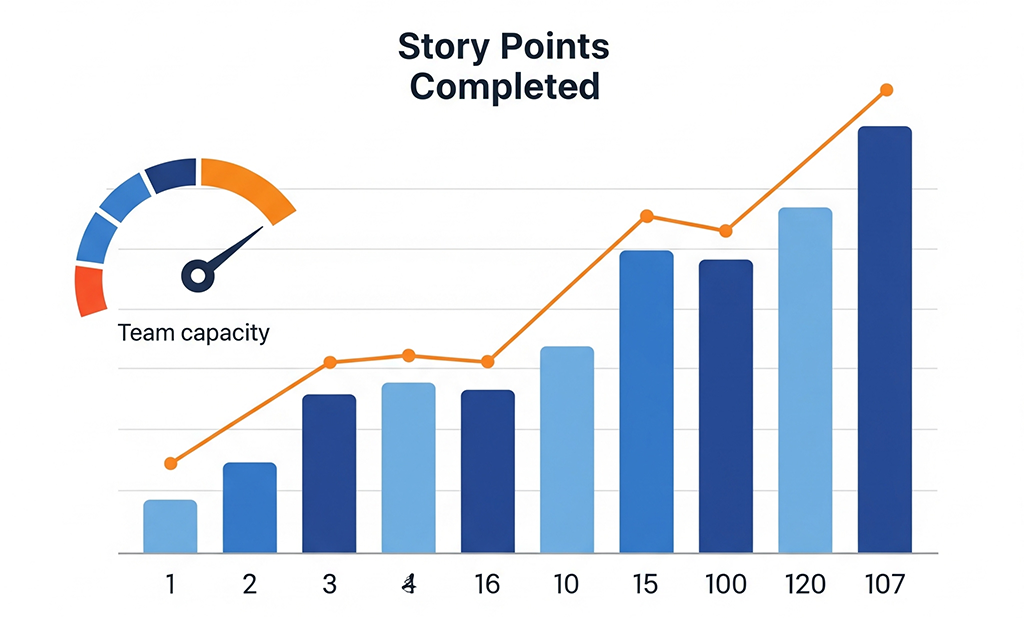
In simple terms, Team Velocity is the amount of work an Agile team completes during a single Sprint.
This amount is usually measured in Story Points or, less commonly, in ideal hours.
The formula is simple:
If you plan five User Stories worth 8, 5, 3, 2 and 8 points, and by the end of the Sprint you complete all of them except the final 8-point story, your Velocity for that Sprint is 18.
One important rule: only completed work counts.
Partially completed work does not contribute to Velocity. There are no “half points”.
What is velocity really used for?
The real purpose of Team Velocity is not to measure how quickly developers write code or how hard the team is working.
Velocity is primarily a tool for planning and predictability.
It helps answer a practical question:
How much work can we realistically commit to in the next Sprint?
If the team’s Velocity over the last three iterations was 20, 22 and 19, the Product Owner can plan the next Sprint around an average capacity of approximately 20 points.
Velocity is therefore a calibration mechanism, not an acceleration target.
The biggest mistake: using velocity as a performance KPI
One of the most dangerous mistakes an organization can make is treating Team Velocity as a performance target.
Here is why.
1. Velocity is relative, not absolute
A Story Point for Team A may have a completely different meaning from a Story Point for Team B.
Comparing the Velocity of two different teams is therefore meaningless.
Velocity is useful inside the same team over time, but it should not be used to rank or compare different teams.
2. Point inflation
Imagine management says:
“I want Velocity to increase by 10% next month.”
The team may consciously or unconsciously start estimating a 3-point task as a 5-point task.
The numerical Velocity increases, but the amount of work delivered remains exactly the same.
The metric has improved, while performance has not.
3. Quality can suffer
When pressure is placed on numerical Velocity, teams may start cutting corners to close tickets and collect Story Points.
This can lead to lower quality, more technical debt and short-term decisions that create problems later.
Three rules for using team velocity correctly
To turn Velocity into a useful tool instead of a harmful metric, follow three simple rules.
1. Look at the trend, not a single sprint
Fluctuations are normal, especially when a team is still learning to work together.
What matters is the overall trend.
A mature team usually develops a relatively stable Velocity range, for example between 28 and 32 points.
That stability makes planning more reliable.
2. Use it for capacity planning
A practical approach is to use the average Velocity from the previous three Sprints, sometimes called Yesterday’s Weather, to decide how much work to include in the next Sprint.
This helps reduce overcommitment, team burnout and stakeholder frustration caused by unrealistic promises.
3. Combine velocity with other metrics
Velocity should never be analyzed in isolation.
Combine it with metrics such as:
- Cycle Time
- Lead Time
- Work In Progress
Together, these indicators provide a much clearer picture of workflow efficiency.
Velocity is a planning tool, not the destination
Team Velocity is like the rev counter in a car.
It tells you how the engine is running and helps you understand when to change gear.
But it is not the speedometer, and it is certainly not the destination.
The goal of Agile is not to maximize Story Points.
The goal is to deliver value in a predictable, sustainable and reliable way.
If the value delivered to customers is high, Velocity is simply one number on the dashboard.
Ready to Bring Order to the Chaos?
Don’t let your projects manage you. Take control today. Mokapen is the intuitive, fast and powerful tool to plan, track and deliver your projects on time.