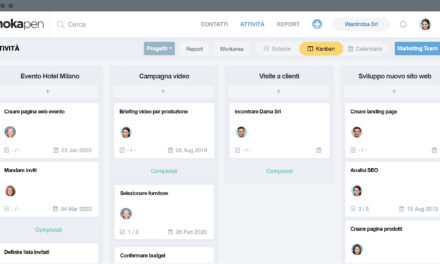
When sales opportunities increase, relying on memory, emails or an Excel spreadsheet can become risky.
A quote is sent and then forgotten.
A customer asks to be contacted the following week, but nobody follows up.
A deal still appears to be open, even though it has actually been inactive for weeks.
The problem is not necessarily a lack of customer interest.
What is often missing is simply a clear way to understand where each deal stands and what needs to happen next.
This is where a sales pipeline comes in.
In brief
A sales pipeline helps you keep track of opportunities, understand where each deal stands and identify what needs to happen next.
A simple pipeline should make it easy to see:
- which opportunities are open;
- what stage they are in;
- who is responsible for them;
- what the next activity is;
- which deals require attention.
The goal is not to create a complex sales process, but to make sure no opportunity is lost simply because the next step was forgotten.
- What is a sales pipeline?
- Why a pipeline helps you avoid losing opportunities
- A simple pipeline is often better than a complex one
- Every opportunity should have an owner
- Every open opportunity should have a next activity
- What information should be associated with each opportunity?
- How to tell if a deal is stuck
- Not every opportunity should remain open
- Sales pipeline and CRM
- How to get started
What is a sales pipeline?
A sales pipeline represents the different stages a sales opportunity goes through.
In practice, it helps you visualize the journey from a contact’s first interest to the closing of the deal.
A simple pipeline could look like this:
New lead → Contacted → Qualified → Quote sent → Negotiation → Closed won / lost
Each opportunity is placed in the stage that best describes its current status.
Instead of having a simple list of contacts, you can quickly understand:
- which opportunities have just entered the pipeline;
- which customers have already been contacted;
- which quotes have been sent;
- which deals require a follow-up;
- which opportunities are close to closing;
- which deals have been won or lost.
A sales pipeline is therefore not just a way to “see your sales”.
Above all, it helps you understand what needs to happen next.
Why a pipeline helps you avoid losing opportunities
Imagine having ten open quotes.
Without a structured process, your information could be scattered across:
Without a pipeline
Email · calendar · Excel · WhatsApp · personal memory
With a pipeline
Opportunity · stage · owner · next activity · deadline
The problem appears when you need to answer a very simple question:
Which customers do I need to contact today?
If answering that question requires checking emails, notes and different files, your sales process depends too much on individual memory.
A pipeline gives you an immediate view of your opportunities and their status.
Sales management therefore becomes a shared process rather than a series of personal reminders.
A simple pipeline is often better than a complex one
One of the most common mistakes when building a pipeline is creating too many stages.
For example:
New contact → First contact → Second contact → Interested → Very interested → Demo → Quote → Quote opened → Quote reviewed → Negotiation → Almost closed → Closed
On paper, this may look very precise.
In practice, however, it becomes difficult to understand when an opportunity should actually move from one stage to another.
For a small business, it is often better to start with just a few clear stages.
A simple structure could be:
1. New lead
A new contact or request has arrived.
You have not yet verified whether there is a real sales opportunity.
2. Contacted
The first contact has taken place.
For example:
- phone call;
- email;
- meeting;
- information request;
- demo.
3. Qualified
You have confirmed that there is a real need and that the opportunity is worth pursuing.
Not every contact should necessarily become a sales opportunity.
4. Quote sent
A commercial proposal has been prepared and sent.
From this point on, it becomes particularly important to have the next follow-up already defined.
5. Negotiation
The customer is evaluating the proposal and there may be requests, changes or comparisons underway.
6. Closed
The deal has been completed.
It can be:
Every opportunity should have an owner
Knowing which stage a deal is in is not enough.
It should also be clear who is responsible for it.
Every opportunity should therefore have at least one owner.
This avoids situations such as:
“I thought you had called them.”
“I thought someone was already following up on the quote.”
Every open opportunity should have a next activity
This is probably the most important rule.
Every open opportunity should have a next step.
For example:
- call the customer on Friday;
- send the quote;
- schedule a demo;
- send a presentation;
- check a technical request;
- ask for feedback on the proposal.
A deal without a next activity can easily come to a standstill.
The pipeline tells you where the opportunity is.
The next activity tells you what you need to do to move it forward.
They are two different pieces of information, but they need to work together.
It is precisely the absence of this mechanism that often leads to forgotten quotes and customers.
On this topic, you can also read Why you lose customers — and how to stop forgetting follow-ups.
What information should be associated with each opportunity?
You do not need dozens of fields to get started.
A few useful pieces of information may be enough.
For example:
- customer or company;
- contact person;
- potential value;
- pipeline stage;
- owner;
- opening date;
- next activity;
- next follow-up date;
- related quote;
- key notes.
The goal is not to collect as much data as possible.
It is to have the information you need to quickly decide what to do and what to prioritize.
How to tell if a deal is stuck
A pipeline becomes particularly useful when it helps you identify opportunities that are no longer moving forward.
Some warning signs may include:
- a quote sent many days ago with no follow-up;
- no future activity scheduled;
- an opportunity that has remained in the same stage for too long;
- no owner assigned;
- too much time since the last contact.
This turns the pipeline from a simple list of deals into a real operational tool.
The question is no longer:
“How many opportunities do we have?”
but:
“Which opportunities need attention today?”
Not every opportunity should remain open
Another good practice is to avoid keeping deals open for months when they are no longer genuinely active.
If a customer has decided not to proceed, chosen a competitor or stopped responding after several attempts, it may be more useful to close the opportunity as lost.
A pipeline full of inactive deals gives you an unrealistic picture of your actual sales potential.
It is better to have fewer opportunities, as long as they are genuinely active.
A pipeline should help people work, not just create reports
Charts, percentages and forecasts can be useful.
But for a small business, the first goal of a pipeline should be much more practical:
help people understand what they need to do.
A good pipeline should make it easy to answer questions such as:
- which opportunities are open?
- what stage are they in?
- who is responsible for them?
- which quotes have been sent?
- who do I need to contact?
- which deals are stuck?
- what is the next step?
If these answers are immediately available, the pipeline is already doing its job.
Sales pipeline and CRM
A pipeline can also be managed with simple tools.
But as customers, activities and people increase, it becomes useful to connect each opportunity to the full history of the relationship.
In a CRM, for example, the same opportunity can be connected to:
contact → company → activities → email → meetings → quote → follow-up
This way, the pipeline does not remain isolated but becomes part of the overall customer management process.
This is one of the main purposes of a CRM: turning scattered information and activities into a shared process.
If you want to explore the topic further, you can also read the complete guide CRM and customer management for small businesses and SMEs.
How to get started
You do not need to build a complex sales process right away.
You can start with five steps:
1. Define 5–6 clear stages for the deal.
They should represent real changes in the sales process.
2. Add only genuinely active opportunities.
Avoid filling the pipeline with deals that are no longer active or realistic.
3. Assign an owner to every opportunity.
It should always be clear who is responsible for the customer.
4. Always add a next activity.
Every open opportunity should already have its next step defined.
5. Regularly review stalled deals.
Check which opportunities are no longer moving forward and require attention.
The real goal is not to have a perfect pipeline.
It is to avoid losing a good sales opportunity simply because nobody remembered to take the next step.
Want to bring more order to your customer management?
Download the CRM Starter Kit: a practical guide to organizing contacts, activities, opportunities and follow-ups in a clearer, more shared process.